Artificial Intelligence (AI) has become an essential part of education. From generating notes and summarizing chapters to solving coding problems and improving writing, AI for students is changing the way people learn. Tools like ChatGPT, Google Gemini, and Claude can save time, explain difficult concepts, and make studying more efficient.
However, AI should be used wisely. Many students rely too heavily on AI without verifying the information they receive. Although these tools are powerful, they are not perfect. Even Google reminds users that Gemini is AI and can make mistakes, so it’s important to double-check important information.
In this guide, we’ll explore the Common AI Mistakes Students Should Avoid, understand how AI learning from mistakes improves over time, discuss examples of AI based mistakes made by companies in general, and share practical AI learning tips for responsible and effective learning.
Why Students Should Be Careful While Using AI
AI can assist with learning, but it should never replace critical thinking. Students who depend entirely on AI may struggle to develop problem-solving skills, creativity, and subject knowledge.
Here are a few reasons to use AI carefully:
- AI may provide incorrect or outdated information.
- It sometimes misunderstands complex questions.
- AI-generated content may lack proper context.
- Overusing AI can reduce independent learning.
Using AI as a learning assistant rather than a replacement for studying leads to much better results.
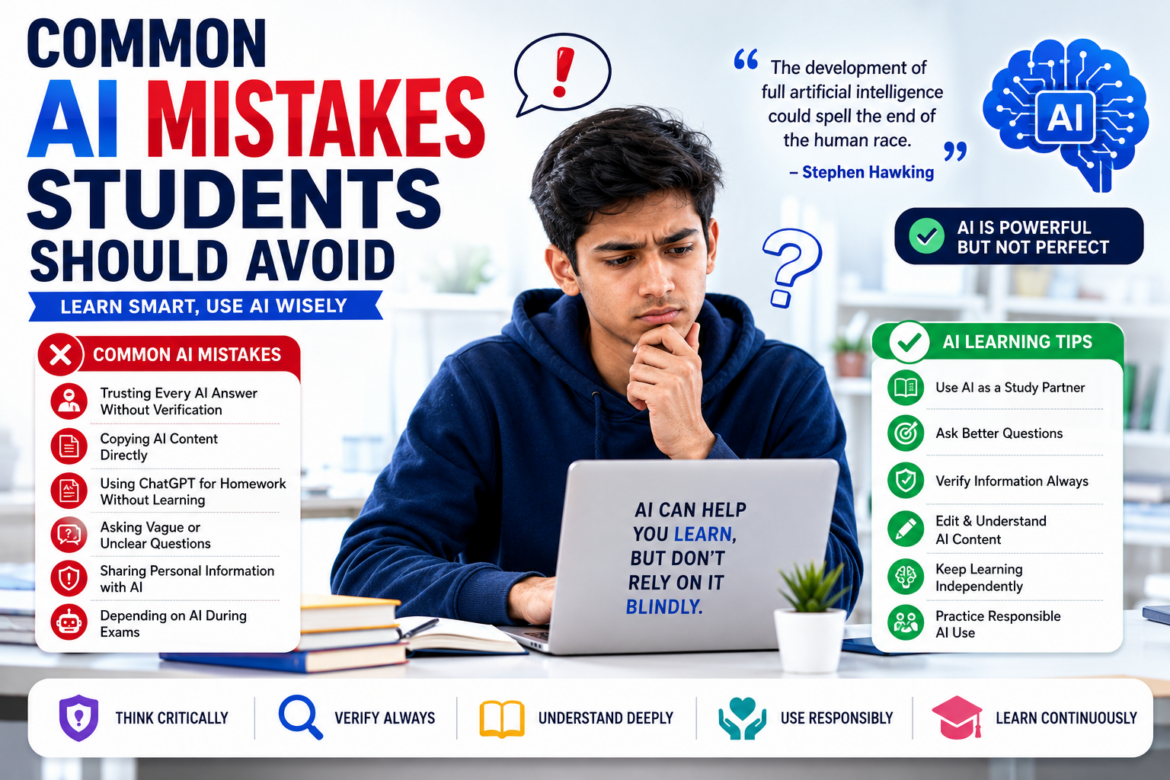
Common AI Mistakes Students Should Avoid
1. Trusting Every AI Answer Without Verification
One of the biggest major mistakes in AI usage is assuming every answer is correct. AI generates responses based on patterns in data, which means it can occasionally provide inaccurate or misleading information.
Before using AI-generated content in assignments or projects:
- Verify facts from trusted books or educational websites.
- Cross-check statistics and dates.
- Confirm references before citing them.
2. Copying AI Content Directly
Many students make the mistake of copying AI-generated text without understanding it.
Instead:
- Read the response carefully.
- Rewrite it in your own words.
- Add your own ideas and examples.
- Understand the topic before submitting assignments.
This improves learning and helps avoid plagiarism.
3. Using ChatGPT for Homework Without Learning
Many students are using ChatGPT for homework because it provides quick answers. While this can save time, depending on AI for every assignment can weaken your understanding of the subject.
A better approach is to ask AI to:
- Explain difficult concepts.
- Solve one example step by step.
- Create practice questions.
- Suggest revision notes.
Learning should always come before copying answers.
4. Asking Vague Questions
AI performs much better when your instructions are clear.
Instead of asking:
“Explain biology.”
Try asking:
“Explain photosynthesis in simple language with real-life examples suitable for Class 10 students.”
The more detailed your question, the more useful the answer is likely to be.
5. Ignoring AI Limitations
Every AI tool has limitations.
For example, Gemini is AI and can make mistakes. Similarly, other AI assistants can misunderstand prompts, produce incorrect information, or confidently present inaccurate answers.
Always remember:
- AI is a helpful assistant, not an all-knowing expert.
- Human judgment is still essential.
6. Sharing Personal Information with AI
Never enter sensitive information into AI tools, such as:
- Passwords
- Banking details
- Personal identification numbers
- School login credentials
- Private documents
Protecting your privacy is an important part of responsible AI use.
7. Depending on AI During Exams
Some students try to use AI to answer every question during exam preparation without studying the concepts.
AI should support revision by:
- Explaining difficult topics.
- Creating quizzes.
- Generating summaries.
- Suggesting practice exercises.
Real understanding comes from consistent study and practice.
AI Learning From Mistakes
One interesting aspect of modern AI is AI learning from mistakes. Developers improve AI models by studying errors, collecting user feedback, and refining training methods. This helps future versions become more accurate and useful.
However, this does not mean AI automatically learns from every individual conversation. Improvements typically come through updates made by the organizations that build and maintain the models.
As a student, you can also learn from mistakes by reviewing incorrect answers, asking follow-up questions, and comparing information from multiple reliable sources.
AI Based Mistakes Made by Companies in General
AI has helped businesses automate many tasks, but there have also been examples of AI based mistakes made by companies in general. These include:
| AI Mistake | Possible Impact |
|---|---|
| Incorrect chatbot responses | Customer confusion |
| AI-generated inaccurate information | Loss of trust |
| Poor content moderation | Harmful content remaining online |
| Biased decision-making | Unfair outcomes |
| Automation errors | Incorrect recommendations |
These examples remind us that AI is a tool created by humans and should always be monitored and reviewed.
Can AI Make a Mistake?
The simple answer is yes—AI make a mistake is a real possibility.
AI can:
- Misinterpret questions.
- Generate incorrect facts.
- Provide outdated information.
- Confuse similar topics.
- Produce misleading references.
That’s why experts recommend verifying important information before relying on it.
Understanding Major Mistakes in AI
Some of the major mistakes in AI happen because of:
- Insufficient or biased training data.
- Ambiguous user prompts.
- Lack of current information.
- Complex reasoning challenges.
- Misunderstanding context.
Being aware of these limitations helps students use AI more effectively.
AI Learning Tips for Students
Following these AI learning tips can help you get the best results while avoiding common mistakes.
✔ Use AI as a Study Partner
Ask AI to explain concepts rather than simply giving answers.
✔ Ask Better Questions
Specific prompts usually produce more accurate and useful responses.
✔ Verify Information
Always cross-check important facts with reliable educational resources.
✔ Practice Critical Thinking
Think about whether the AI’s answer makes sense before accepting it.
✔ Edit AI-Generated Content
Rewrite responses in your own words and add your own understanding.
✔ Keep Learning Independently
Continue reading textbooks, attending classes, and solving problems without depending entirely on AI.
Responsible AI Use
Responsible AI use means using AI ethically, safely, and intelligently.
Students should:
- Use AI for learning rather than cheating.
- Respect academic honesty policies.
- Protect personal information.
- Verify important facts.
- Give credit where required.
- Use AI to improve skills instead of replacing effort.
When used responsibly, AI becomes a valuable educational assistant rather than a shortcut.
Did Stephen Hawking Say AI Is the Biggest Mistake of Mankind?
Many people search for the Stephen Hawking quote AI is the biggest mistake of mankind. This phrase is widely circulated online, but it is not a verified direct quote from Stephen Hawking.
Stephen Hawking did express concerns about the potential risks of advanced AI if it were developed without proper safeguards. His broader message emphasized the importance of responsible development and oversight of artificial intelligence, rather than rejecting AI altogether.
It’s a good reminder that quotations found online should always be verified before sharing them.
Benefits of Using AI the Right Way
When used responsibly, AI can help students:
- Understand difficult subjects.
- Save time on research.
- Improve writing skills.
- Practice coding.
- Generate study plans.
- Create revision notes.
- Learn more efficiently.
The key is to treat AI as a learning assistant, not as a replacement for genuine understanding.
Quick Checklist for Students
| Do’s | Don’ts |
|---|---|
| Verify AI answers | Copy assignments directly |
| Ask detailed questions | Trust every response blindly |
| Learn concepts first | Depend completely on AI |
| Protect personal data | Share sensitive information |
| Edit AI-generated content | Submit AI text without review |
Frequently Asked Questions
Can AI make mistakes?
Yes. AI systems can generate incorrect, outdated, or misleading information. Always verify important facts using trusted sources.
Is using ChatGPT for homework okay?
Yes, using ChatGPT for homework can be helpful if you use it to understand concepts, generate practice questions, or review material. Avoid copying answers without learning.
Why does Google say Gemini is AI and can make mistakes?
Google includes this reminder because AI-generated responses are not always accurate. Users should verify important information before relying on it.
What is responsible AI use?
Responsible AI use means using AI ethically, protecting privacy, verifying information, and using it to support learning rather than replace it.
Can AI replace teachers?
No. AI is a valuable educational tool, but teachers provide guidance, experience, personalized feedback, and human interaction that AI cannot fully replace.
Conclusion
Artificial intelligence is transforming education and making learning more accessible than ever. However, understanding the Common AI Mistakes Students Should Avoid is just as important as learning how to use these tools effectively. Whether you’re studying with ChatGPT, Google Gemini, or another AI assistant, remember that AI can occasionally produce incorrect information, misunderstand questions, or lack important context.
The best approach is to combine AI with critical thinking, independent study, and reliable educational resources. By following good AI learning tips, practicing responsible AI use, and treating AI as a helpful study partner instead of a replacement for learning, students can improve their knowledge while avoiding common pitfalls.
Used wisely, AI can become one of the most powerful tools in modern education—helping students learn faster, think more deeply, and prepare for a future where AI skills will be increasingly valuable.