Students today have more ways than ever to find information. Earlier, Google Search was the obvious starting point for almost every question. Today, AI tools can answer questions, explain difficult concepts, summarize information, generate ideas, and help students learn.
This has created an important question: AI vs Google Search — which is better for students?
The answer isn’t as simple as choosing one over the other. Google Search and AI search work differently, and each has advantages depending on what a student wants to accomplish.
In this guide, we’ll compare AI search vs Google, look at AI for studying, research, homework, accuracy, speed, and explore when students should use traditional Google Search and when an AI tool may be more useful.
AI vs Google Search: What’s the Difference?
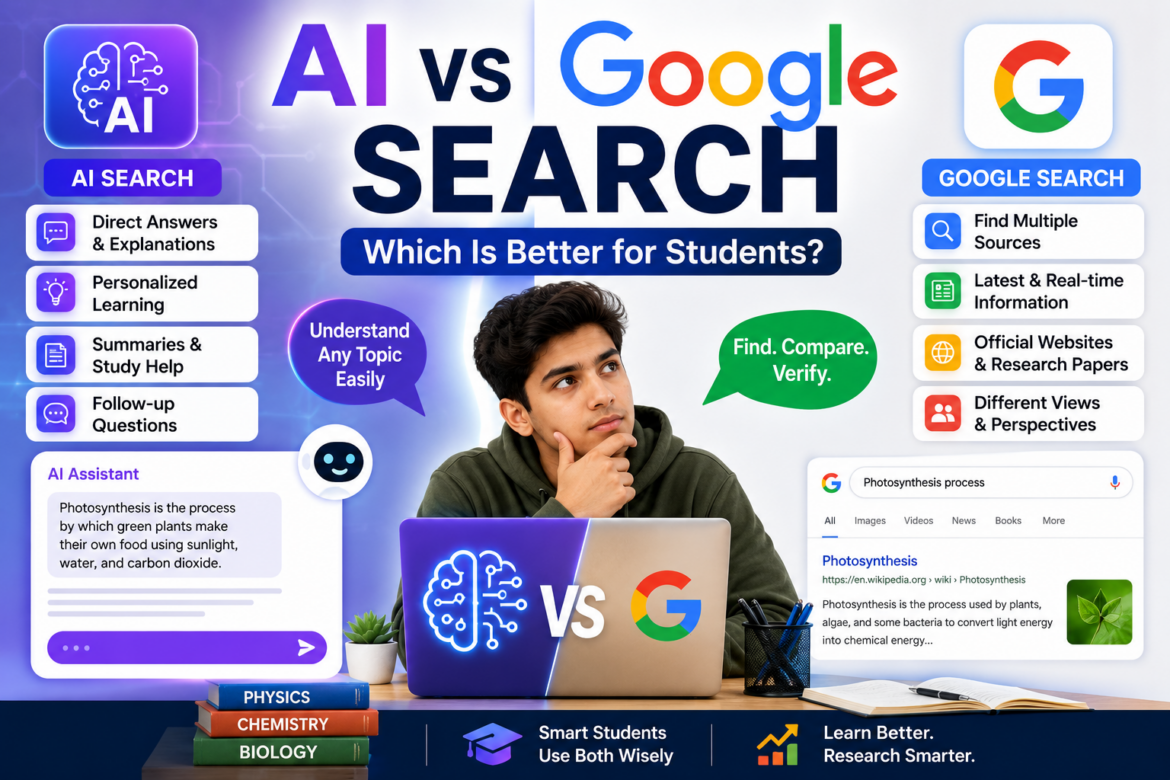
The biggest difference between Google Search and AI is how they provide information.
Google Search primarily helps you find information on websites. You enter a query, and Google provides links, snippets, images, videos, maps, and other results.
AI search tools can provide a direct conversational response. Instead of opening several websites and reading through them, you can ask an AI tool to explain a topic in a particular way.
For example, suppose a student asks:
“Explain photosynthesis to me like I’m 12 years old.”
A traditional Google search may show several educational websites, while an AI assistant can provide a customized explanation immediately.
This doesn’t mean AI is always better. Google can be more useful when you need original sources, official information, recent news, or several perspectives.
AI Search vs Google: How Do They Work?
Understanding the difference between AI search vs Google can help students choose the right tool.
Google Search
Google generally works as a discovery tool. It helps you find:
- Websites
- Research papers
- News
- Videos
- Images
- Official documents
- Educational resources
- Forums and discussions
You usually need to evaluate the results yourself.
AI Search
AI tools can work more like an assistant. You can ask follow-up questions and request explanations in different formats.
For example:
“Explain this chapter in simple language.”
Then:
“Give me five important questions from this chapter.”
Then:
“Create a revision table.”
This conversational approach can make AI for studying particularly useful.
AI for Students: When Is It Better?
AI search for students can be useful when the main goal is understanding rather than simply finding a webpage.
Students can use AI for:
- Explaining difficult concepts
- Creating study notes
- Brainstorming ideas
- Generating practice questions
- Summarizing information
- Creating study plans
- Understanding mathematical concepts
- Learning programming
- Practicing languages
For example, if you’re struggling with a complicated economics concept, you can ask an AI assistant to explain it using a simple example and then ask follow-up questions.
This is one area where AI can be more convenient than traditional search.
Google Search: When Is It Better?
Despite the growth of AI, Google Search remains extremely useful for students.
Google is often the better option when you need:
1. Original Sources
If you’re writing an academic assignment, you may need to find the original research paper rather than relying entirely on an AI-generated explanation.
2. Current Information
Search engines can help you find recent news, official announcements, updated policies, and newly published information.
3. Multiple Opinions
Google lets you compare information from multiple websites.
4. Official Websites
For scholarships, university admissions, examination dates, government information, and application procedures, students should usually go directly to official websites.
5. Specific Resources
If you know exactly what you’re looking for, Google can quickly locate the relevant webpage, PDF, video, or document.
AI vs Google for Research
The question of AI vs Google for research is particularly important for college students.
AI can help with the beginning of the research process. For example, you can ask:
“What are the major causes of climate change?”
The AI can help you understand the major concepts and suggest areas to investigate.
You can then use Google to locate:
- Academic papers
- Government reports
- University publications
- Scientific organizations
- Original research
- Reliable statistics
Therefore, rather than thinking of AI and Google as competitors, students can use them together.
A Better Research Workflow
Step 1: Use AI to understand the topic.
↓
Step 2: Identify important concepts and questions.
↓
Step 3: Search Google for reliable sources.
↓
Step 4: Read the original sources.
↓
Step 5: Compare information.
↓
Step 6: Write your own explanation.
This approach is much safer than simply copying an AI answer.
AI for Research Students
For AI for research students, AI can be useful for brainstorming research questions, explaining terminology, organizing ideas, and summarizing documents.
However, students should be careful about relying on AI-generated references.
AI systems can sometimes provide incorrect information or citations that don’t exist. Always verify important references using Google Scholar, university databases, journals, or the original publication.
AI should therefore be treated as a research assistant, not as the final authority.
AI Search Tools for Students
There are now many AI search tools for students and AI assistants available.
Depending on the tool, students can use AI to:
- Ask questions
- Summarize documents
- Explain concepts
- Generate study questions
- Analyze text
- Brainstorm project ideas
- Improve writing
- Practice coding
But students shouldn’t choose a tool simply because it gives the longest answer.
The most useful tool is the one that helps you understand and verify information.
Google vs AI Search for Homework
The Google vs AI search debate becomes especially interesting when students are doing homework.
Imagine you need to understand a mathematical formula.
Google can help you find:
- Tutorials
- Videos
- Textbook explanations
- Practice problems
AI can explain the same concept interactively.
You might ask:
“Explain this formula step by step and give me three practice questions.”
Then you can ask:
“Don’t give me the answer yet. Give me a hint.”
That makes AI useful as a learning partner.
However, students should avoid simply asking AI to complete an assignment and submitting the response without understanding it.
Solving Problem by Searching in AI
The idea of solving problem by searching in AI is becoming increasingly common.
Instead of searching for individual pieces of information, students can describe the entire problem to an AI assistant and ask for guidance.
For example:
“I understand the first part of this physics problem, but I don’t understand how to calculate the final value. Can you explain the next step without giving me the complete answer?”
This type of interaction can encourage learning rather than copying.
The important distinction is between using AI to understand a problem and using AI to avoid solving it yourself.
AI vs Google: Which Is More Accurate?
Neither AI nor Google should automatically be considered 100% accurate.
Google can display inaccurate information because not every webpage is reliable.
AI can also make mistakes, misunderstand questions, or provide outdated information.
Therefore, students should develop a habit of verification.
For important information:
AI answer → Google search → Original source → Verify
This is especially important for:
- Academic research
- Medical information
- Statistics
- Historical claims
- Scientific information
- Government rules
- University requirements
AI vs Google: Which Is Faster?
For straightforward questions, both can be fast.
However, AI can save time when you need an explanation rather than simply a webpage.
For example:
Google:
Search → Open website → Read → Compare information.
AI:
Ask → Receive explanation → Ask follow-up questions.
On the other hand, Google can be faster when you already know the exact website or source you’re looking for.
What About Google Lumiere AI?
You may also encounter the keyword Google Lumiere AI while researching AI-related topics.
Lumiere is associated with AI-generated video research rather than being a direct alternative to Google Search. It demonstrates how AI technology can generate and understand visual content.
For students researching AI, it is an example of how quickly AI capabilities are expanding beyond simple text-based questions.
However, Google Lumiere AI is not directly relevant to the AI vs Google Search comparison, so students shouldn’t confuse AI video-generation technology with AI search.
What Are “Add Me to Google Search” Queries?
Some Google-related keywords appearing in search data have completely different search intent.
For example:
- add me in Google Search
- google add me to search
- add me to Google Search
- add me to Google Search card
- add me to search” on Google
- add yourself to Google Search
These searches are generally about appearing in or interacting with Google’s search presence and are not directly related to the question of AI search vs traditional search.
Similarly, AI search icon can refer to the interface or visual representation of an AI search feature rather than the broader question of which search method is better for students.
Different Types of AI Search
Students researching artificial intelligence may also encounter technical terms such as:
Blind Search in AI
Blind search in AI refers to search methods that explore possibilities without using additional knowledge about which direction is most promising.
Best First Search in AI
Best first search in AI is a search strategy that selects the most promising option based on an evaluation function.
Iterative Deepening Search in AI
Iterative deepening search in AI combines characteristics of depth-first and breadth-first search by gradually increasing the search depth.
Random Search in AI
Random search in AI explores possible solutions using random choices rather than systematically following a particular path.
What Is Heuristic Search in AI?
If you’re wondering what is heuristic search in AI, it is a method that uses additional information or estimates to guide the search toward potentially better solutions.
These concepts are part of AI search algorithms, which are different from the modern AI-powered search assistants discussed in the rest of this article.
Difference Between Informed and Uninformed Search in AI
The difference between informed and uninformed search in AI is that informed search uses additional knowledge or a heuristic to guide the search, while uninformed search operates without such domain-specific guidance.
These technical AI search concepts are useful for computer science students, but they shouldn’t be confused with AI-powered web search.
AI vs Google Search: Comparison Table
| Feature | AI Search | Google Search |
|---|---|---|
| Direct explanations | Excellent | Limited |
| Finding websites | Limited | Excellent |
| Follow-up questions | Excellent | Limited |
| Finding original sources | Good | Excellent |
| Learning concepts | Excellent | Very good |
| Current news | Depends on tool | Excellent |
| Academic research | Useful starting point | Excellent |
| Multiple sources | Moderate | Excellent |
| Personalized explanations | Excellent | Limited |
| Homework guidance | Excellent | Good |
| Source verification | Requires checking | Excellent |
| Brainstorming | Excellent | Limited |
Should Students Use AI or Google?
The best answer is: use both.
Students shouldn’t think about AI vs Google as a competition where one tool must completely replace the other.
Instead:
Use AI when you need:
- An explanation
- Brainstorming
- Study assistance
- Personalized examples
- Summaries
- Practice questions
- Step-by-step guidance
Use Google when you need:
- Original sources
- Current information
- Official websites
- News
- Research papers
- Multiple viewpoints
- Specific webpages
Using both tools together can create a much more effective learning process.
AI vs Google Search for Students: Final Verdict
So, AI vs Google Search: which is better for students?
There is no universal winner.
AI is generally better when students need conversation, explanations, personalization, brainstorming, and study support.
Google Search is generally better when students need original sources, current information, official documents, and multiple perspectives.
The smartest approach isn’t to choose one and ignore the other. Use AI to understand and explore a subject, then use Google to verify important information and find reliable sources.
Most importantly, students should avoid becoming completely dependent on AI. The goal of technology should be to improve learning, not replace learning.
Frequently Asked Questions
Is AI better than Google Search for students?
AI can be better for explanations, brainstorming, and personalized learning, while Google is better for finding original sources and current information. Using both is often the best approach.
Is Google better than AI for research?
For finding original research papers, official documents, and multiple sources, Google and academic search platforms can be extremely useful. AI can help students understand and organize the information.
Can students use AI for studying?
Yes. Students can use AI for explanations, revision questions, summaries, brainstorming, and study planning. They should still verify important information and follow their school’s AI policies.
Should I use AI or Google for homework?
It depends on the task. AI can explain concepts and provide hints, while Google can help locate tutorials and educational resources. Students should use these tools to learn rather than simply copy answers.
What are the best AI search tools for students?
The best option depends on the student’s needs. Look for tools that provide useful explanations, allow follow-up questions, and make it possible to verify important information.
Can AI replace Google Search?
AI is unlikely to completely replace traditional search for every use case. Both approaches have different strengths, and students can benefit from using them together.
Is AI accurate?
AI can provide useful information but can also make mistakes. Always verify important academic, scientific, financial, medical, or current information using trustworthy sources.
Conclusion
The debate over AI vs Google Search isn’t really about choosing a single winner. For students, both technologies can play different roles.
AI can act like a personal study assistant that explains difficult concepts, generates practice questions, and helps organize ideas. Google Search remains extremely valuable for discovering websites, research papers, official information, current events, and multiple perspectives.
The most effective student workflow is therefore simple: use AI to learn and explore, use Google to search and verify, and use your own judgment to decide what information you can trust.
As AI search continues to develop, students who learn how to use these tools responsibly will have an advantage—not because AI does their work for them, but because they know when to ask AI, when to search Google, and when to verify information themselves.